


PFAS-free membrane for functional fabrics
Recently, the news that “ Texas Attorney General Ken Paxton announced an indictment against Lululemon USA, a well-known Canadian sportswear brand, investigating whether its products contain "permanent chemicals," namely per- and polyfluoroalkyl substances (PFAS)-1. Paxton stated sternly, "I will not allow any company to use the guise of health and sustainability to sell harmful, toxic materials to consumers at exorbitant prices."" has attracted considerable attention in the functional fabrics industry.
Similar incidents have become increasingly common in recent years, highlighting a key weakness in the industry: while pursuing ultimate functionality, the health, safety, and environmental sustainability of functional materials are becoming a growing focus for consumers and regulators.
As is well known, PFAS is a collective term for over 14,000 synthetic chemical substances. Due to the extreme stability of their carbon-fluorine bonds and their remarkable resistance to degradation in the natural environment, they are considered "permanent chemicals." This characteristic is precisely why it is so popular in the field of functional materials—waterproof, oil-proof, and heat-resistant, making it a core component of waterproof and breathable membranes and DWR (durable water-repellent) treatments in functional clothing such as outdoor jackets and sportswear.
However, studies have shown that exposure to certain PFAS may lead to various health problems, such as endocrine disorders, thyroid disease, immune system suppression, elevated cholesterol levels, and kidney and testicular cancer.
With these health risks, PFAS has faced increasingly stringent regulations globally. On January 1, 2025, California's AB 1817 law officially took effect, prohibiting the manufacture, distribution, or sale of any textiles containing regulated PFAS within the state; New York State also simultaneously implemented a ban on PFAS in clothing. In the European Union, the EN 17681-1:2025 standard requires that the total organic fluorine in textiles not exceed 50 ppm, while the REACH regulation is pushing for a complete ban on the production, use, and market placement of PFAS. China has also included PFAS in its "List of Key Controlled New Pollutants."
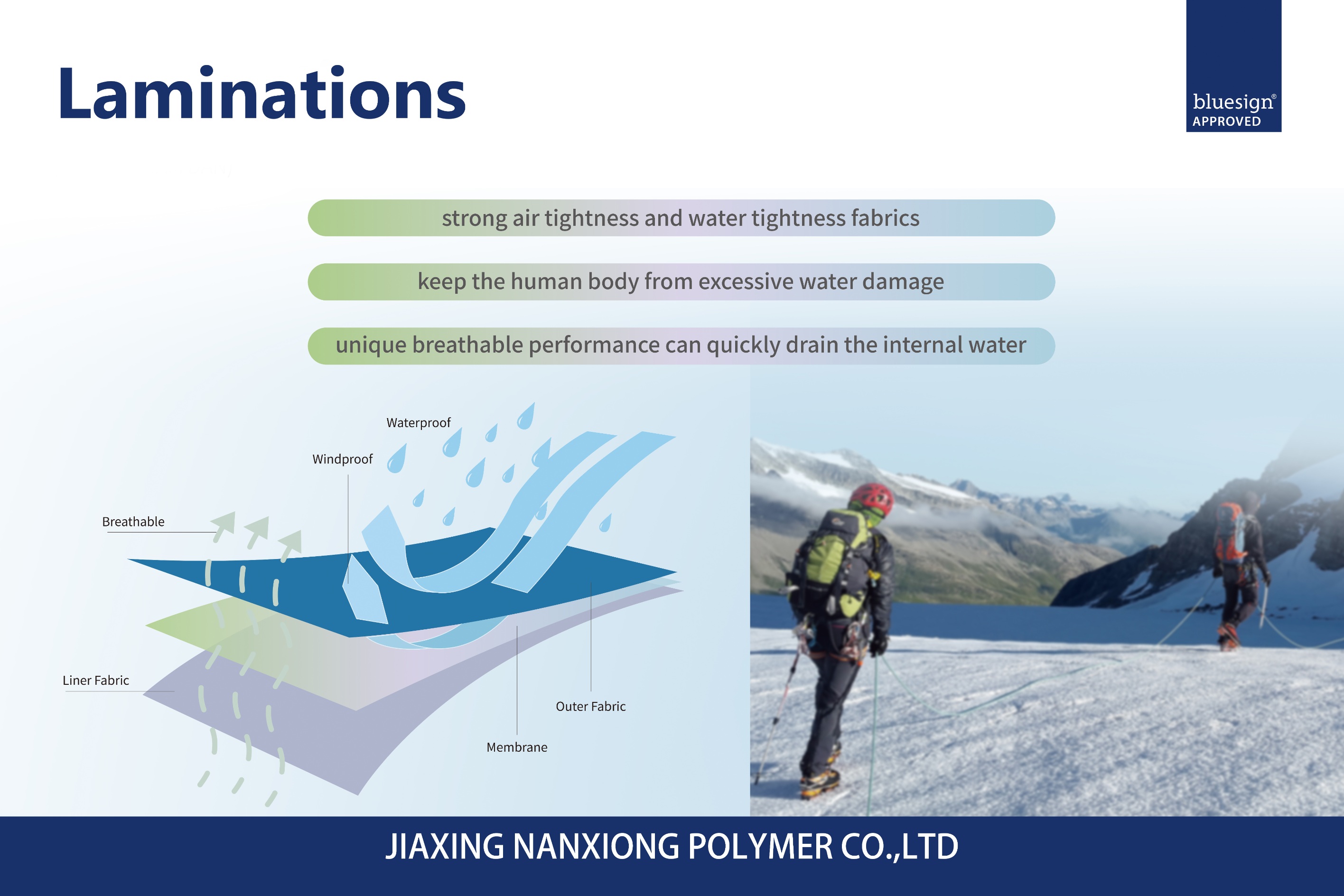
High-performance waterproof and breathable membranes have always been a core technological barrier for functional clothing. These materials must both prevent liquid water penetration and allow sweat to escape as water vapor, finding wide application in outdoor sports, military equipment, and medical and health fields.
Currently, waterproof and breathable membranes on the market are mainly divided into two categories: hydrophobic microporous membranes represented by expanded polytetrafluoroethylene (ePTFE), and hydrophilic non-porous membranes represented by thermoplastic polyurethane (TPU). Among them, ePTFE has long held a dominant position in the industry due to its excellent waterproof and breathable properties and extremely high stability.
However, PTFE materials involve fluorinated compounds. As the environmental and health risks of PFAS become increasingly prominent, the industry must find new solutions.
TPU membranes are undoubtedly the first-generation choice for fluorine-free alternatives. Thermoplastic polyurethane (TPU) waterproof and breathable membranes have simple raw material components and are processed without solvents. They also possess good temperature and weather resistance, as well as being environmentally friendly and recyclable, making them the preferred material for fluorine-free films.
In recent years, the successful development of fluorine-free bio-based membranes has been a major breakthrough in the research of defluorinated materials. These membranes use bio-based polymers (with a bio-based content of up to 20%) instead of petroleum-based polymers, making the raw materials green, environmentally friendly, sustainable, and renewable, thus aligning better with the trend of sustainable development.
The Lululemon investigation has sounded an alarm for the entire industry, highlighting a historic crossroads for functional materials. The ultimate goal of this transformation is not only to produce safer clothing but also to leave a more sustainable future for consumers, the environment, and future generations.
As a manufacturer of fluorine-free functional films, Jiaxing Nanxiong has always adhered to its core principles: respect for life and protection of the environment, consistently leading the way in the research and development and production of green and environmentally friendly materials. Since its establishment in 2007, Nanxiong has not only consistently produced TPU films of various sizes, specifications, and properties, but also continuously researched and improved these properties. Currently, it can reliably supply fluorine-free hydrophilic TPU/PU/TPEE films and microporous PU/PP films, which are widely used in various industries such as outdoor clothing, footwear, gloves, home textiles, automobiles, medical devices, and inflatable products. Nanxiong has been continuously researching and making breakthroughs in the development of sustainable, renewable, green, and energy-saving materials, successfully launching GRS TPU/TPEE films, as well as biomass TPU and PU films, with stable performance and sufficient production capacity.
Featured News
-
 New green material –bio-based TPAE membrane
New green material –bio-based TPAE membrane TPAE , short for Thermoplastic Polyamide Elastomer , is a kind of green material with strong tensile strength and extension ,with good temperature res...
-
 What are the key trends and growth drivers in the TPU Membrane industry, and how are manufacturers responding to them?
TPU (Thermoplastic Polyurethane) Membrane is a versatile material that finds application in various industries such as textiles, medical, automotive, and construction, among others. The TPU membrane i...
-
 TPU blackout film for curtain
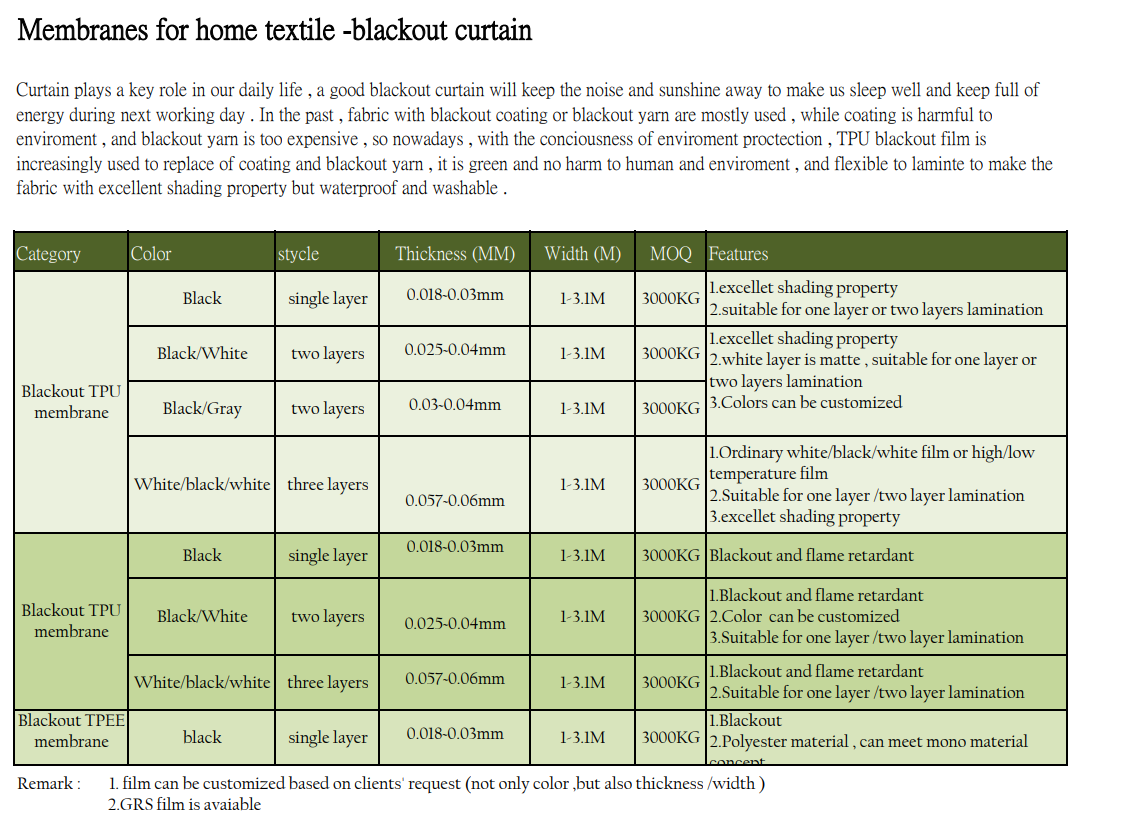
TPU blackout film for blackout curtain for household or hotelCurtain plays a key role in our daily life , a good blackout curtain will keep the noise and sunshine away to make us sleep well and keep f...
-
 the difference between POE micor porous membrane and PTFE membrane
the difference between POE micor porous membrane and PTFE membrane 一. Performance characteristics 1. Air permeability PE microporous membrane: It has a certain air permeability and can allow g...
-
 Is TPU more expensive than PVC?
● Introduction The world of polymers brings us a variety of materials that play crucial roles in different industries due to their unique properties and applications. Two of the most discussed polymer...
-
 Is polyurethane film safe?
polyurethane film has become an integral part of various industries, from medical to automotive sectors. With its versatility and durability, it has transformed how products are manufactured and appli...



Copyright © Jiaxing Nanxiong Polymer Co., Ltd.TPU Film Manufacturer