


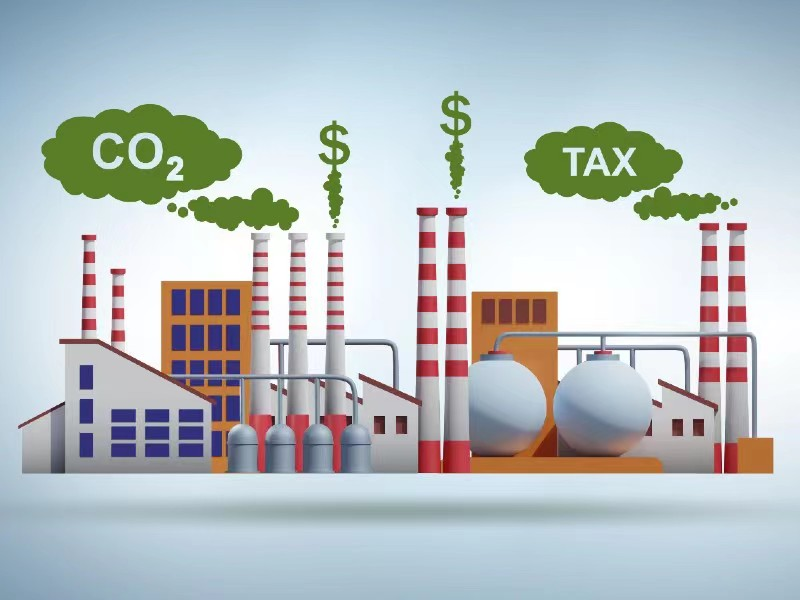
EU will impose carbon tariff from 2027
On June 22, 2022, the European Parliament voted to approve the proposal of the Carbon Border Adjustment Mechanism (CBAM), which is an amendment to the "draft" of the European Commission. This will be followed by a discussion of the European Parliament's opinion by the Council of the European Union. If the Council of the European Union fully accepts the opinion of the European Parliament, the bill is passed. Now the European Parliament, the European Commission and the European Council have all formed their own CBAM plans. Next, we will see whether the consensus plan can be reached through the "tripartite talks". It is expected that the entire legislative process will be completed before the end of 2022.
If the EU Council fully accepts the "first reading" text of the European Parliament, the EU will impose a "carbon tariff" from 2027 on products ranging from: steel, aluminium, electricity, cement, fertilizers, organic chemicals, hydrogen, ammonia , plastic, etc., and will expand the product range to all sectors covered by the European Union Carbon Market (EU ETS) by 2030.
Important adjustment of Carbon Border Adjustment Mechanism
|
|
Council position |
EU Parliamentary position |
|
Time arrangement |
Transitional period :2023-2025 Start from Year2026 |
Transitional period :2023-2025 Start from Year2027 |
|
Initial covered products |
iron and steel, aluminum, electricity. cement, fertilizer, |
iron and steel, aluminum, electricity, cement, fertilizer, organic chemicals, hydrogen, and ammonia, polymers (plastics)
|
|
Type of emission |
Direct emissions |
Direct emissions indirect emissions |
|
Definition of direct emission |
Emissions from production processes directly controlled by the producer |
Emissions from production processes directly controlled by the producer, including heating and cooling emissions |
|
Definition of indirect emission |
Emissions from Power generation, heating and cooling |
Emissions from Power Generation |
|
Extend covered products range in the future |
By the end of 2025, start collecting relevant information for analyzing |
By the year 2030,it will expand the product range to all industries covered by the EU ETS . By June 2025, come up with a timetable for expanding the product range, prioritizing the industries with the highest carbon leakage and carbon emission intensity . By the end of 2025, Add downstream products to current CBAM controlled products. |
Featured News
-
 How is TPU membrane used in textiles
TPU membrane is commonly used in textiles as a laminate or coating to enhance the performance of fabrics. Here are some ways in which TPU membrane is utilized in textile applications: Waterproof and ...
-
 What are the characteristics of TPU film
TPU is more environmentally friendly than PVC. TPU and Hyundai's concept of environmental protection are attracted to each other and are loved. Regarding the characteristics of TPU film, we specially ...
-
 The current TPU film industry faces opportunities as well as challenges do you know?
TPU granules are made into TPU film through calendering, cast, blown film, coating and other technologies. Currently it is mainly used in sports shoes, it is widely used in the sole and the upper of t...
-
EU will impose carbon tariff from 2027
On June 22, 2022, the European Parliament voted to approve the proposal of the Carbon Border Adjustment Mechanism (CBAM), which is an amendment to the "draft" of the European Commission. This will be ...
-
 What are the advantages of TPU fabrics?
Advantages of TPU:1. Excellent wear resistance. Especially under the working conditions where there are wetting media such as water and oil, its wear resistance is often several times and dozens of ti...
-
 Introduction to Polyurethane
Polyurethane (PU) is the abbreviation of polyurethane, which is made of polyisocyanate and polyhydroxy polymer addition, and is a polymer compound containing many repeated carbamate chain segments (-N...



Copyright © Jiaxing Nanxiong Polymer Co., Ltd.TPU Film Manufacturer